
Home » Blog

You can’t do it wrong… Sometimes, it just takes time to get it right!

You can't do it wrong

One of Resistance‘s biggest allies is our fear of “doing it wrong”; In western culture (and a couple of others also, most notably Japan), we are taught from the get go that everything has to be perfect at first creation, and that failure is something to be avoided at all costs.

Thinking mindfully however, where we learn that All life experiences teach you, these days I’m not afraid to fail. Some of the best things I’ve learned in life have been through monumental cock-ups.

For instance, in my day-job, in my early days of working with Group Policy Admin, I learned how the system worked through a huge error – I didn’t realise that unless you saved the policy work done a certain way, the system didn’t retain the security filters placed on it –  and so I hid everyone’s C:\ drive, rather than just the C:\ of the intended group of computers.

This mistake was easily undone, and the cock-up I made here, along with the lesson I learned from making it, saved me from doing something with the system at some point down the line that would have been an million times worse!

I have a very healthy attitude to failure now – I approach all things in a state of playfulness – which is the state that the limbic brain likes the best. Yes, making mistakes is disruptive, so learning, testing and planning  before hitting the go button is the way I do things now, knowing that I have the skills to ensure success, so it will probably be OK, but also knowing that if I do break it, I also very much have the capability to fix it again.

It’s that pushing through to ensure that things do work out OK if they do go wrong that is the key. For instance, as an inventor, Thomas Edison made 1,000 unsuccessful attempts at inventing the light bulb. When a reporter asked him, “How did it feel to fail 1,000 times?” Edison replied, “I didn’t fail 1,000 times. The light bulb was an invention with 1,000 steps.”

Edison learned vital things from his first 999 tries that lead to his eventual success. If he had have given up at the first failure (or even felt resistance so much that he didn’t even try!), we would probably all still be using candles!

There is also another dimension to ‘You can’t do it wrong’ however, which is all about second guessing oneself. This is more the “will I make the wrong choice” type of doing it wrong than anything else – and it’s again firmly rooted in resistance as your amygdala feeds past experience feeling/memory into your current choice giving fear for the future outcome.

Combating that one is a mixture of being present in the now and trusting your gut feeling to instinctively make the right choice. A choice made in the now will always be the right one, as you will have collected enough information about the issue for your subconcious to know what is right, even if your concious mind hasn’t caught up yet. You just need to be still and listen to yourself.

However, listening to the fear feedback loop caused by your amygdala’s need for stasis will lead to procrastination and inaction. Unfortunately, your Amygdala has a loud voice, and so learning how to reach past that and get out of your own way whilst making a choice is an art in itself.

If you think it all sounds like a great deal of effort, you are not wrong. And Resistance will try and make you not learn the skill at every turn. It is well worth being persistent however, and even though it took me a couple of years to even begin to get the trick of getting out of my own way, learn to find the quiet in the now and make that choice, the only time I ever receive a bad outcome is when I’ve second guessed myself. I’m still on the journey with this one, but every time I practise the skill, the easier it is to exercise it. And life is just so much easier as a result!

Are you ready to join me? Make a commitment now to be present. Leave me a comment below about your experiences in this area, and we can start working on connecting those dots.

Catch you next week!

Image used “Deciding Which Door to Choose 2” by Vic
Used Under Creative commons licence: Attribution 2.0 Generic (CC BY 2.0)

Intermission…

August was a very weird time – an all too brief 4 day visit from one of my partners, two funerals, a wedding and the Nineworlds Geekfest conference sandwiched in between them – All very exhausting emotional things – followed by a period of “brain fuzz” from “doing all the stuff”, so not much room for the inspiration needed to write to take effect.

I’ve wanted to write my next post (“You can’t do it wrong“) for the last three weeks, but my brain simply didn’t want to give me “words” of any shape.  I did manage to journal a little bit about one of the funerals (to aid creating white space in my brain) but I know there is way more in there that needs to come out. When I’ve not been at work (doing “the minimum needed to get by and keep projects moving”), I’ve spent most of my time either sleeping, fussing over my orchids/watching YouTube videos on Orchid care and finishing up re-watching S7 of Buffy the Vampire Slayer.

Now, I could chose to beat myself up over this seeming “waste of time”, and a few years ago I very much would have done, feeling all the guilt around “doing nothing” and I would have tried to force “things to work”, which would inevitably lead to life not working at all and even more “things not happening” in life as I wallowed and flailed.

However, taking the Mindful view on things, I simply acknowledge that having had a very emotion filled and time sapping beginning to August,  I needed some time to reset. And my doing that self-care and taking that time to get back in the flow is not something that is “bad” or “wrong”, it is something that just “is”. And I have no need at all to feel bad about that at all.

Take my work here for instance. I dedicated myself to producing world-changing content once a week, and my lack of words to the world since the beginning of August could be seen as a massive failure. I could sit here in a puddle of self-recrimination and self-doubt, allow that negativity to enable me to listen to my amygdala and simply give up on my writing and myself  – because changing the world takes effort… and that equals resistance.

I do know that for the last week or so, where my brain has been up and firing again, that I have been very subject to resistance. I’ve been wallowing, “filling up my eyes” in a rather drastic way, doing anything to seemingly avoid writing or creativity (Although I have been spending lots of time with my Orchids!).

However, using that resistance as my compass, and knowing that my time-out allowed my brain to heal, enough is enough and it’s time to push on through! It’s time to give thanks and forgiveness in my life, open up to abundance and start shining again.

I’m hoping that I’ve given you reassurance and food for thought. Have you had a time where you felt that everything was just too much? How did you cope then? And are you now working Mindfully and with Gratitude to accept that sometimes life hands you a shit sandwich (to quote Marie Forleo!) and that you have to deal and move along. Leave me a comment below, and we can start working on connecting those dots.

Catch you shortly!

Image used “Intermission (5/7)” by jnyemb
Used Under Creative commons licence: Attribution 2.0 Generic (CC BY 2.0)

“Resistance” – Your cue to keep going!

resistance is beautiful

The brain is a funny thing – I know that you are here, reading this, because in some way, you want to improve yourself. I’m here writing it because I want to do the same, improve myself and our world by shining a light to help others improve themselves and the world around them.

But we all suffer from “Resistance” – the negative force inside all of us that wants to maintain the status quo, wants to not “feel the fear” but to “stay safe” and to hide away from change and growth. Because change could harm us right? Best not do that then, just stay here in our nice little world and be secure, even if we rationally hate it and want, even need to change it…

The need to “stay safe” comes direct from the Amygdala, AKA the “reptile” brain, which operates as a part of the Limbic brain, but at an even lower level – Evolutionary studies show that this is the part of the brain system that we have now that evolved first. One of its jobs is to be in charge of the part of “fight or fight” (our instinctual decision making and emotional response) that is based on previous emotional memory patterns.

So, why is our learning to discern when this little nugget of our brain is activated important to our progress? When the Amygdala is activated, it makes our gut feelings on something not quite so trustworthy as usual, as it is basing its reaction on past emotional memory patterns, usually formed when we are very young.

Like the limbic brain, it has no language or sense of time, it acts in the now to keep us alive and safe, and will always point towards short term satisfaction and pleasure over long term gain. (As an aside, it’s also the part of your brain responsible for weird and irrational snap decisions around instant gratification – that sweet sticky doughnut you ate cos it tastes nice, or those lovely new shoes that you have no idea why you bought for instance! Marketers play heavily to this instinctual behaviours as they lay out shops, they know how to make your Amygdala give you a short term gain “happy”!)

This “short term view” can make us freeze in our tracks or even run away when a “big unknown” comes up; something that we’ve never encountered before may well be harmful! This can very much rob us of the want to act for our own greater good. Where the Neocortex knows that progress towards “a long term change towards greater good” will improve us and our world, the Amygdala puts up “stay safe, be happy in your now, don’t change” signals.

Nite that when the Amygdala signals, these are taken by the brain as a whole to be the appropriate reaction response to the situation – Limbic reacts faster than rational Neocortex. And so the Neocortex gets overruled and we feel Resistance.

Resistance takes many shapes: fear, self-doubt, procrastination, distraction, addiction, timidity, ego and narcissism, self-loathing and perfectionism, to name a few. I’m sure that you’ve feel these come up in your lives, I know I have in mine! (Procrastination is the main way my resistance shows itself. I’ve learned ways to turn it to my advantage, but that’s a whole ‘nother post!)

Knowledge is power however, now you know why you are feeling resistance, and because we can actively gauge and use the strength of the Resistance we feel against “the good thing that we want to do” we can use that as a compass.

After all, as Steve Pressman says in “Do the work”: Resistance wants us to not move away from our current state of mind; it’s a negative, repelling force. It will outright lie to us, fabricate reason after reason for us not to act, and cajole, seduce or bully us into not moving forward.

However, Resistance, being negative, is always lying, and it is totally full of bullshit.

The fact that resistance is always a liar means that when we are feeling the most resistance to an new idea or change, that is when we most need to act, using the feelings of resistance to guide us towards the calling or purpose that we know that we must follow. The more important that work is to us, however much we want to achieve our goals towards “greater good”, as the “greater good” grows so does the resistance we will feel towards our perusing them.

The work (your ideas, dreams and goals) can be anything: Writing a book, dropping your excess body fat, lifting weights to gain muscle, learning how something works so that you are more able to support yourself in using it, designing and launching a website to share your ideas, painting, creating or drawing something and then showing it to people or embarking on a 6-month around the world adventure – all these things have long-term gain for the good in common. They all pretty much require short-term pain of some form: planning, organising, potential financial shortfalls or simple courage of convictions to press on.

There are a few ways to combat the Amygdala, and so, armed with this new knowledge, what are you feeling resistance against doing in your life? What goal in your life are you procrastinating around doing, or fussing over “because it has to be perfect”? Leave me a comment below about what your resisting, and we can start working on connecting those dots.

Catch you next week!

Image used “Resistance is Beautiful” by teofilo
Used Under Creative commons licence: Attribution 2.0 Generic (CC BY 2.0)

Declutter – good things happen when you do.

simplify

As I said last week, I’ve been doing personal development work on my “money stuff”, generally working on discovering and clearing my money blocks and creating an abundance mindset. (Disclosure: Affiliate links)

Part of creating abundance is about allowing it to enter your life. Now, spiritually, I’m a Pagan, so the concept of Magic is nothing new for me. I’m very comfortable with knowing that the Universe/Field of Potentiality/Divinity has my back, that intention is all and that you have to do the work to enable the universe to meet you half way to give you what you request (chance favours the prepared mind and all that).

However, in my Pagan practices, I’d learned that you make the intention, ask divinity for it and then release it, trusting that the intent will become. It’s praying,  one asks for a thing just the once; mithering at the problem will cause doubt/loss of clarity which confuses the universe i.e. diluting the power of the prayer.

However, where I’ve been diving deeper into Mindfulness, improving my mindset from Lack to Abundance as well as working out how this can then serve both myself and others, I’ve been reading around “cosmic ordering” and manifesting (The Law of Attraction) as they are often in the same books!

I’ve been giggling at the various authors describing the principles of magic and asking the Universe for things without referring to the divinity of it at all,  but it has made me pay more attention to my own spirituality, and I’ve been revisiting my views and beliefs around the power of intention.

“Declutter!” is pretty much the first step in all manifesting/cosmic ordering writings (as well as it being a major principle of Feng Shui), as having clutter hanging about confuses intent. Denise Duffield-Thomas has a wonderfully practical video on making manifesting foolproof where she talks about the decluttering step in detail.

This is because decluttering is not just about space (though for the last 3 weeks, I’ve been decluttering my house with gusto!), it’s very much also about decluttering our thoughts.

We all collect “static” over the years, we build stories around what has happened to us – scripts – that give us words that then shape experiences. Not all these scripts are helpful or even useful to our future lives; “History is a very good teacher, but not all of the lessons are good ones” is a phrase I often use.

Recognising and then working to declutter the negative scripts that we’ve built into our world view is important; simply put, they hold us back. The universe gives us what we expect to receive, so if our scripts are saying things like

  • “Oh, I’m so fat!”
  • “I hate my body/nose/tummy/bum.”
  • “I never win anything.”
  • “Why do I always have a headache?”
  • “I’m so tired all the time.”
  • “I hate my job.”
  • “I never have any money.”

then that is exactly what the universe will keep giving!

So, this week I want you to start listening to yourself, how much negative clutter are you carrying around in your head? Some of our negative scripts can be re-framed as positives, some we can recognise why we are thinking that way and work to make a change easily but others just plain need ditching. Leave me a comment below about what you’ve found about your thoughts, and we can start working on connecting those dots.

Catch you next week!

Image used Trim (lock) by
Used Under Creative commons licence: Attribution 2.0 Generic (CC BY 2.0)


Can you “sit still” or do you need to “fill up your eyes” ?

Sit Still Or Fill Up Your Eyes

I’ve been doing personal development work the last 10 days or so, working on some of my “money stuff”, generally working on discovering and clearing my money blocks, creating an abundance mindset and specifically around making crucial mindset shifts for making passive income (Disclosure: Affiliate links) because hey, I want to create content and courses that improve the world, be a successful female entrepreneur role model for the next generation and gain clarity in my own world so I can help you to connect your dots and improve your life!

I love Denise Duffield-Thomas, she is just so down to earth, practical and totally speaks to the way I think about life. (NB: This is so important. You must resonate on a positive and human level with the people you work with and listen to in life. A good coach will turn you away if she feels that you will not work well together. Stress and combat over “personality-issues” do not make for successful self-improvement!)

Some of the work I’ve been doing has been all about my “sitting still”; being in the moment, breathing, focusing and listening to various messages. This made me think about how we “fill up our eyes” these days – using our Smartphones (Which are actually the ultimate personal computer) and tablets to “just check in”, “play a game” or various other activities that really just waste time and aren’t really engaging with the world or ourselves.

I remember when I was a kid, technology was really just breaking into the home environment, the mobile was a good 15 years away. So, as well as watching telly, I read books, played out, built things, made cakes, talked to my friends for hours on the phone. I could also “sit still”, because I didn’t feel the need for the “need to be doing” i.e. 100% engagement/stimulation, at all time. I look at my behaviours now, and the behaviours of my friends children, and we are all attached to our technology! We are “filling up our eyes” with minutae, most of which we don’t actually need to know, and some of which (especially for children) isn’t actively developing cognitive connections.

I’ve not denying that our level of tech. can be very useful; it is definitely life improving, and provides valuable learning and problem solving tools, but I’ve actively had to remember how to reach stillness again, remind myself that I can “just sit”, that I have no need to get agitated if my phone is not in my hand if there is nothing else going on, that it doesn’t matter if I’m not checking FaceBook or Twitter (the information I really need will find me) and to sit, breathe and also engage to absorb knowledge when I’ve been actively learning new stuff.

I feel that losing this stillness is a big issue. Having stillness in life allows for “reset” time, for me, this is the time where I engage with my orchids, dye my yarn, or just sit for 15 minutes on a sunny day enjoying the sun on my face! I also have concern for the kids who have not actually learned about this stillness in the first place.  Yes, we all know that kids run around and pretty much never sit still, but when they do sit down, I see the automatically reaching for a device as potentially not the best idea for them…

So, can you sit still? Summer’s the perfect time to start to regain this vital skill. This week, I want you all to get out from behind your desk at lunch, go sit in the sun (Or, if you are like me, “sun-adjacent” i.e. in the shade!) and just be in the world for 15 minutes. Enjoy the sun, listen to the world around you, breathe and don’t touch your tech. during that time. Note how it makes you feel. Are you calm and enjoying the time, or agitated that you are taking time out and can’t “fill up your eyes”. Afterwards, are you feeling energised and ready to get back to your day with renewed vigour (hint: this is the desired outcome! 😉 ), or did you just feel a bit silly and fidgety, or that it was a waste of time. Leave me a comment below, and we can work on finding the moment and connecting those dots.

Catch you next time!

Credit for Sitting Still half of image used What is this life if, full of care, we have no time to sit and stare…. by Nagesh Jayaraman
Used Under Creative commons licence: Attribution 2.0 Generic (CC BY 2.0)

Basic orchid care pointers

Ann's Orchid in need of repotting

I love my orchids. I love the colours of their blossoms, the way a fresh flower looks like it’s covered in glitter. I feel happy when their leaves are rigid and shiny, and I love the stillness that my 10 minutes of orchid checking gives me everyday.

A while back, my friend Ann got given an orchid as a house warming present. She was rather scared that she was just going to kill it off, like she had with previous orchids, so she asked me for some pointers.

Most people buy (or are given) Phalaenopsis orchids as the most common ones in the shops. Their blooms are beautiful and, despite the myths to the contrary, are the easiest of all the Orchidaceae genera to care for.

The most common reason why people “fail at orchids” is that they treat them like a normal house plant: park them on a sunny windowsill, water them every couple of days “so they don’t dry out” and often leave them in the puddle of standing water that collects in the base of the pretty ceramic pot they come in.

However, this is exactly the opposite of what they need. They need minimal fussing, dappled sunlight and only a sparing amount of water. This is because they naturally grow attached to the bark of trees in the canopy of the Rain Forests, where life is generally humid but not very out-and-out wet.

Importantly, as well as water, their roots also need both light and air, as Phalaenopsis’ photosynthesise with both leaves and roots. Orchids ship in clear pots for this reason. (Although, some companies pack their orchids with moss into a rubbish flexible PVC pot – these orchids will need re-potting as soon as they finish flowering, as the moss will be stopping air getting to the roots).

Because the roots need air, any standing water can very quickly cause root rot.

The plant usually remains in bloom for ~3 months, the flowers die off then fall off one by one. This is totally normal and not a sign that the plant is dying at all. Also, the very bottom leaf turning yellow and detaching on occasion is also totally normal, this is simply natural wastage, usually in response to humidity levels.

So, this translates at home to:

  1. Usual household temperatures, anything from 16°-28° is generally good. The occasional overnight drop down to ~10° will cause new flower spikes, but consistent cold is bad.
  2. Either a north facing windowsill, or a windowsill that generally doesn’t get more than 2 hours of direct sunlight per day.
  3. A “Drench watering” every other week (or weekly if it’s very warm) – Hold the pot under a running tap – tepid water, not cold –  for a minute or so, also running the water over any aerial roots, then leave to drain totally. Ensure that minimal water remains in the pot, do this by tipping the pot at an angle, this will drain the water that has collected at the bottom of the pot.
    Getting water on the leaves isn’t an issue, but ensure that you don’t get water in the crown. If you do, remove the puddle immediately with the corner of a paper towel. Crown rot will happen if you leave the puddle in there.
  4. Not moving them around too much – picking them up and plonking them down too often “just to peek at them” is bad. Visual inspection and touching the leaves to check rigidity is good, but you only really want to move them around to water them as above.
  5. If you notice the bark drying out quickly, or your house is not very humid then mist them every other day as well.  Leaving them above the water line on a water filled pebble tray is also good.
  6. On visual inspection, you are checking that the bark is not totally dried out (generally, condensation on the inside of the pot should be visible right up until the day before drench watering) and the leaves are rigid –  if the leaves are floppy, the plant is dehydrated – Either mist the plant and the bark heavily, or consider a drench watering. If they are wrinkled, and water is being supplied on a regular basis then the roots are not supplying the leaves with water for some reason. That’s the subject of another article!
  7. Talking to your plants when you inspect them is totally allowed, even encouraged! Giving living things your total focus give you happiness and keeps you in the now. There is also documented science that plants that are spoken to nicely grow better. 🙂

There are “advanced class pointers” around feeding, re-potting and how to spot issues, which I’ll be writing on in coming weeks,  but using these basic tips will keep your orchid thriving and blooming for many years to come. Following these pointers, Ann’s orchid is very happy, and has thrown both a new leaf and a new flower spike!

Have I inspired you to get an orchid, or to start growing things on your windowsill? I do hope so. Leave me a comment below, and we can start connecting those dots.

Catch you next week!

Why Women are vital to STEM

Lego Botany talk

Women are vital to STEM (Science, Technology, Engineering & Mathematics) for one very outstanding reason, beyond intelligence, capacity or ability –  Women provide a different perspective and voice.

That is a weird statement to make, really obvious, and even potentially condescending, but given that STEM is very much dominated by the male perspective and voice, women can and do get shut out. In more ways than the obvious.

I saw this when I attended a Lecture just before Xmas given by Intelligence2 – BRIAN COX AND ALICE ROBERTS ON THE INCREDIBLE UNLIKELINESS OF HUMAN EXISTENCE – Both brilliant minded scientists in their own fields, and yet Brian pretty much dominated the conversation. There was no condescension, and a great deal of respect and some back and forth, but Brian definitely opined more than Alice, and it was an oddness watching Alice (to my perspective) “look for verification” to talk on about subjects, as well as a few times Brian cutting over Alice, and her just letting him ramble on more. It was a good and very enjoyable talk, but it was very much “The Brian Cox Show”, which did mean it was a touch unbalanced.

In audience questions, Brian was directly asked a “trap” question –  “If you had to work in an all-male team, or an all female one, which would you choose and why?”  – and I felt that he handled it rather well. Avoiding the obvious sexism trap, he chattered around it for about a minute, before boiling his answer down to “We need woman in science, because wasting 50% of the brains on the planet is criminal!”

This means to my mind that we have a “two-fold” issue in STEM:

  1. We have a lack of “push” towards “tech” (Duplo/Lego), “logic/puzzles” and “building stuff” (Mechano/just breaking things and putting them back together) at the primary level, mostly from Parents following their own “stereotype education”, steering little Johnny at the “Constructing Things” and little Susie at the “Dolls and Pretties”, (for instance, the segregation/”pinkificaiton” of toys is way more prevalent now than it was when I was a child, (35 years ago!))

I feel that this lack of push for girls towards what ultimately becomes leaning in STEM subjects with following careers means that by the time they are hitting secondary school option time, they are not wanting to pursue a STEM subject, and potentially (depending on socialisation) even see STEM as “Too Manly” for them to want to get involved in!

  1. The “standardised” socialisation of boys and girls (which I never had, thank you again Mum!) will cause issues way beyond learning STEM subjects. Because girls are socialised (in various degrees) to “talk the step back”, “not talk over people”, “be selfless”, “empathise” (and even in some cases, “wait for men to talk first”), when we then find our way to STEM, we have to then “unlearn” that set of behaviours, as that stepping into the STEM world usually demands a “more masculine” communication approach. This is a “double edged sword” of expectations, as behaviours that men see in other men as “forward thinking”, “takes charge”,”gets the job done” (the behaviours that managers seek in the people they want to promote) are seen in woman as “bitchy”, “abrasive”, “aggressive”.

These attitudes are counter-productive, as it causes the loss of female perspective, both on the micro level of day-to-day interaction, and on the macro, as many highly qualified STEM women are now seeking jobs in alternate industries due to this “Old Boy’s Club” gender bias. The double edged sword defeats all of us, regardless of gender.

In plain terms, women tend to think around problems in differing ways to men, and given that most of the big scientific discoveries are made by pure fluke and happy accident, through what’s called “unguided” research (following a research path just for the heck of it, “playing around” with ideas) or by looking at problems from a different perspective, or even research discipline. This need for differing perspective means that the female perspective is needed now, more than ever before! For instance, some of the most exciting research happening now is in Multidisciple/Cross-Discipline facilities. The Crick Institute in King’s Cross is being built on this principle of “Mix it up”, and they are active promoters of female brain talent.

With the world now having massive focus on STEM, and women finally gaining “equal recognition” of our brain power, even if not of our gender yet, we all need to work toward removing the gender bias in STEM.  For my part, I’ve no “pseudo-nieces” (I’ve 4 pseudo-nephews though!) that I can encourage into STEM, so I’ve joined “Inspiring the Future” – to help encourage girls at Secondary level to get into STEM. What will you do?

Catch you next week!

Image used, Visitor Services Specialist by USFWMidWest
Used Under Creative commons licence: Attribution 2.0 Generic (CC BY 2.0)

Pick a craft, any craft…

craft room

Oh my,  last weekend has been hectic, and not in a good way, my partner had a rather awful healthcare experience, mostly in terms of “lack of human touch” quality to the care given by some of the overstretched hospital staff rather that the actual health issue itself. As “Pick your craft/Find your Bliss” is exactly what I had written as last week’s article title, life provided me with the inspiration to write the article, even if the experience wasn’t actually that great in itself..

Hence I’m a week later than I wanted to be in getting a post on this this topic written and out to you all. However, as we sat on the ward, rather bored and awaiting the needed medication bag so escape could happen, both of us wished that we had our knitting with us to keep us occupied, rather than just an iPad to stream media on.

The stress of the tedious not knowing what was going on was rather high, and , any craft that was small enough to be portable would have been a good way to engage the limbic brain “in the now”, rather than allowing the Neocortex to loop around in “what if???” circles. This is because watching a TV show is simply a passive activity, rather than an engaging/active one.

I know that knitting isn’t everyone’s cup of tea, but I do advocate that everyone should have a craft; something creative that can be played in and around with, as often as possible. As well as knitting, I dye yarn and fibre, muck around with watercolour pens and Sharpie(TM) markers (drawing is very much not one of my skills, but I like the “art-sy doodles” I produce), coo and fuss over my orchids (because helping them grow them is definitely an art!) and write, both on my websites and in my journal.

As adults, we generally leave play behind us; it’s seen as childish, a waste of time and something that should no longer be required in the adult world of responsibilities. But this lack of joy through play and creativity is very harmful to us.

Engaging in these craft activities gives me “flow” (“flow” being what psychologist Mihály Csíkszentmihályi describes as “a state of concentration or complete absorption with the activity at hand and the situation … A state in which people are so involved in an activity that nothing else seems to matter.”) – moments of mindfulness where all my brain is doing only one thing, leaving me totally wrapped up in “the now” of the creative moment.

I know that finding flow and having my playful craft activities enhances my day-to-day hum drum. Since I’ve been crafting more, I’ve become generally happier, more able to concentrate, both at home and at work and I find it easier to resolve problems and issues because my attitude is more relaxed and playful about “things”.

So, I want to challenge you to find your bliss as well. What type of craft do you to already that you could find time to enjoy more? Or, is there a playful activity that you’d really like to try? Take action to find that bliss, and then leave me a comment below about it, so we can start working on connecting those dots.

Catch you next week!

Image used, Craft Room by chrissy.farnan
Used Under Creative commons licence: Attribution 2.0 Generic (CC BY 2.0)
Ego – It’s an active blocker to progress

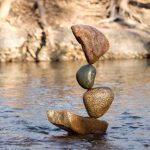
Gravity Glue - Rocks

“But I know this already!” – Potentially the most harmful statement one can make when learning. And, as we are learning all the time, with every experience we live, you may well find that it’s your ego that is stopping your progress.

Thoughts in the vein of “that’s impossible”, “I could never do that”, “I can’t see the benefit”, “that’s no good to me”, or other similar negative statements are blockers to progress. After all, pretty much everything is possible, as long as you are willing to believe in your own power to achieve it. Take for instance Michael Grab – He’s learned that he can balance stones. Finding the correct points on the rocks to make stacks of seemingly impossible towers

If one person can do it, anyone can. You don’t need to be special, or lucky, you just need to check your ego at the door and enter into the project with an open mind.

Conversely, “But what if goes wrong?” is also a massive blocker to progress. Nothing is ever perfect, it never can be. Organic growth is wonderfully flawed, and embracing that is a good thing. Also know, that if it does break, you can fix it, always. Never be afraid to fail.

I’m sure that along the way, Michael failed many many times with the balancing, before he learned how to feel for the balance points and centre the rocks perfectly.

So, I want you to think about a situation where you have felt your ego was in the way of your progress and then leave me a comment below about how you worked to resolve that. Then we can start working toward connecting those dots.

Catch you next week!

Image used under licence and by kind permission of Michael Grab at http://www.gravityglue.com and  https://www.facebook.com/gravityglue

Crap in = Crap out

Body Image

Life is a series of choices, and although all choices are shades of grey, some are more black and white than others.

One of the easiest “black and white” choices we make in life is what we eat. Although there are people that would disagree with me on my views over what I feel “healthy eating” is all about, common ground for all people interested in nutrition is that the quality of the food that we consume is utmost.

For me, I know that when I made the choice in 1999 to stop eating Starches and Sugars, it was motivated from a place of “nothing else works” and my desire to drop 7st (just under 100lbs) of body weight and not much more. At that point however, I didn’t have a great deal of money, and so I chose the cheapest protein options, “junk” foods and “food” made from really not great ingredients but that fit a “low carb” profile.

As you can guess, although I was better off from not giving myself massive insulin spikes and sugar highs all the time, and the upswing in health I received from ditching a “food group” (grains) that I now know really isn’t actually food for Homo Sapiens was remarkable, but as I did more research about how the body works, and came to understand a why low carb diet is the diet that our bodies is evolved to eat, the quality of my food became more and more important.

After all, we literally are what we eat, and if you eat crappy food, your body becomes crappy. And before 1999 I’d been eating all the crap. And my fat body really was sick and crappy.

Food is just one piece of the puzzle though, as I’ve increasingly discovered in the last 15 years, as I worked to let go of ideals that are “crap food for the mind”, the limiting believes that are handed to us, such as “I’m too fat to be beautiful”, “If only I were thinner, I could do xxx”,   “If I just starve myself, I’ll be better”.

All these self-limiting beliefs around “suffering for a result” are really just negative thoughts, which are a self-defeating trap. I’ve worked just as hard to learn that “as my body is worth feeding well, so it can be its best, so is my mind.”

It really doesn’t matter if I’m carrying a bit of extra fat, that fact doesn’t need to stop me being my best or stop me achieving my goals and doing what I want to do.

I hope that you can see parallels for self-improvement here, and so I want you to take action. For the next 3 days, keep a food diary. Not a calorie or quantity diary, a quality diary.  Note how much whole food you eat vs. how much processed crap, how many meals you cook from real ingredients vs. ready-meals and/or low-calorie, sugar loaded products that you buy and ding in 5 minutes. Are you putting crap in and just expecting a non-crappy body to result?

Once you’ve done that, work to shift away from the grains and the crap, and into honouring your body with proper nutrition! Then note how that makes you feel. I’m hoping that it will give you an emotional boost, however, it you encounter feelings of body-shame, resistance or even annoyance, then that is where we need to also do some work on your internal thoughts around food and body image.

Come back and leave me a comment below about your food achievements and feelings, and then we can start working toward connecting those dots.

Catch you next week!

Image Body Image by Charlotte Astrid
Used Under Creative Commons Licence: Attribution 2.0 Generic (CC BY 2.0)